7 Hydraulic Crawler Drill Buying Tips for Global Buyers
A Hydraulic Crawler Drill is a major investment, and its real value shows up on site: in stable feed, reliable penetration, and fewer hours lost to maintenance. Buyers working across different geology, climates, and service networks need more than a high-power specification. They need a machine suited to the ground and the crew operating it. Small details count.
The International Energy Agency’s Global Critical Minerals Outlook 2024 reports that the market value of key energy-transition minerals doubled over five years, reaching about US$320 billion in 2022. That growth adds pressure to develop mineral projects efficiently, but it does not make every drill suitable for every site. Buyers still need to check rock conditions, hole diameter, mobility, fuel use, parts availability, and operator support. A brochure rarely shows the full picture.
Mining engineer Mark Cutifani, former CEO of Anglo American, has emphasized productivity and safety in mining. Paraphrased for equipment purchasing, his practical lesson is to judge a machine by safe, repeatable site performance—not headline capacity. This guide turns that principle into seven buying checks, from drilling needs to after-sales service. Ask for field references and realistic maintenance intervals. Then compare the numbers with your own operating conditions. No model is perfect. A missed assumption about ground hardness or spare-part delivery can outweigh an attractive purchase price.
Define Project Requirements and Ground Conditions
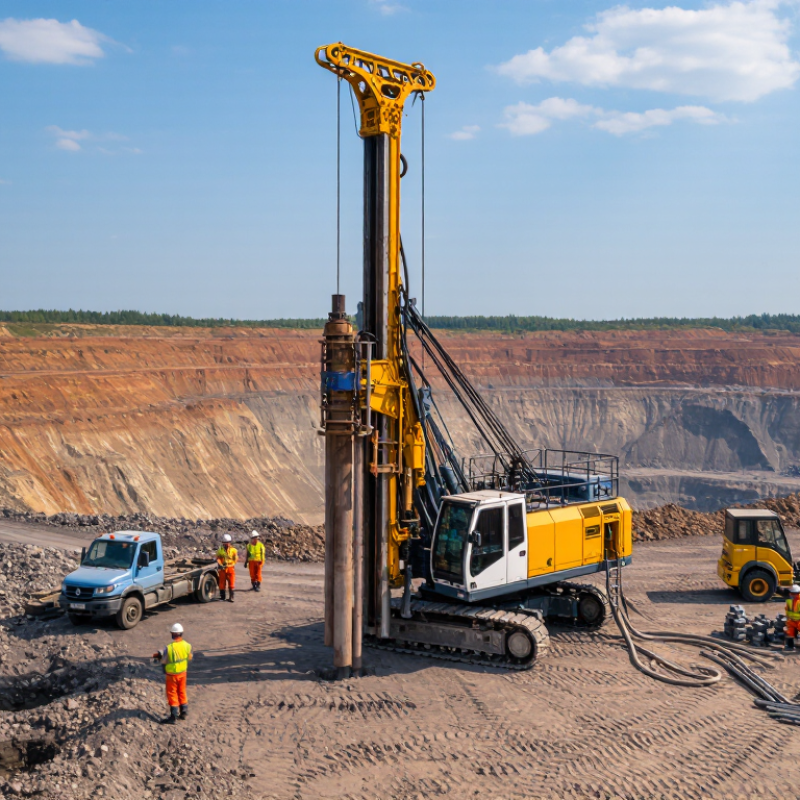
Before comparing crawler drills, define the work in measurable terms: hole diameter, depth, inclination, daily metres, and relocation frequency. A 90 mm anchor hole on a narrow bench needs a different setup from a deep blast hole across a broad quarry face. Record access limits too: turning radius, track pressure, and transport width can decide whether a machine reaches the collar safely. Small details matter.
Ground data should come from bore logs, core samples, groundwater observations, and, where available, rock-mass testing. FHWA’s 2002 Geotechnical Engineering Circular No. 5 discusses Rock Quality Designation (RQD); the widely used Deere scale rates 0–25% as very poor and 90–100% as excellent. These figures help frame rock quality, but RQD alone cannot predict drilling speed. Fractures, clay seams, weathering, and water may change tool wear and hole stability. The ground is rarely uniform.
Match the machine’s feed force, rotation torque, compressor capacity, and rod-handling system to the site evidence. Ask suppliers to state assumptions behind quoted penetration rates, including bit type and shift conditions. Compare those assumptions with a short field trial, if practical. A clean sample can mislead. One weak point in planning is relying on a single test location; add test holes across changing strata, and note uncertainty rather than hiding it.
Use ground-strength data as an initial drill-selection guide. Rock-strength class boundaries can vary by standard; confirm site conditions with geological surveys and testing, and also assess fractures, abrasivity, groundwater, hole diameter, and drilling depth.
Compare Hydraulic Crawler Drill Types and Configurations
Compare Hydraulic Crawler Drill Types and Configurations
Hydraulic crawler drills commonly use top-hammer or down-the-hole systems. Top-hammer models suit smaller holes and faster pattern drilling in competent rock. Down-the-hole configurations can deliver steadier performance in larger, deeper holes. Actual results depend on rock conditions, operator practice, and maintenance. The International Energy Agency’s Global Critical Minerals Outlook 2024 reports that lithium demand rose 30% in 2023, while demand for nickel, cobalt, graphite, and rare earth elements increased by 8–15%. This signals growing pressure on mineral supply, but it does not predict drill sales or determine the right rig for a site.
Tips: Match hole diameter and depth to the drilling system before comparing horsepower. Check mast reach, feed force, compressor capacity, and dust-control equipment. On a narrow bench, measure the crawler’s working width and turning space. A heavy rig may feel stable, yet struggle on soft ground. That trade-off is easy to miss on a specification sheet.
Compare standard and long-feed configurations against actual blast patterns, not maximum advertised depth alone. Ask operators to assess visibility from the cab, hose access, and how quickly they can reposition between holes. Remote controls may help in restricted areas, but they add setup and training needs. Keep the comparison practical: request sample operating data from similar geology, then verify fuel use and availability of routine parts. Even good data can be imperfect when rock conditions change across one site.
Evaluate Key Performance and Technical Specifications
When comparing hydraulic crawler drills, match rated drilling diameter and depth to the rock and work plan. A machine’s maximum figures are not everyday output. Check rotation torque, speed range, and feed force together; high torque alone may not suit fractured ground. Ask for performance data under conditions similar to your site, not only ideal test conditions.
Look closely at the hydraulic system’s flow and pressure requirements. Confirm they support the drilling head without overheating during sustained work. Check compressor capacity if the setup uses pneumatic flushing, and verify rod length, mast angle, and hole alignment range. Small details matter. On uneven ground, track width, ground clearance, and leveling range affect stability around the collar. Inspect dust-control equipment and access to filters, hoses, and service points. These features can influence daily uptime more than a headline power rating.
Request a witnessed test with the intended drill rods and a representative rock sample. Record penetration rate, fuel use, and temperature after a steady operating period. A clean test pad can hide real-site problems. I’d also compare transport dimensions and machine weight against the buyer’s actual routes and lifting equipment. Specifications are useful, but they can still leave gaps; ask suppliers to clarify how each figure was measured.
Check Manufacturer Quality, Support, and Parts Availability
A hydraulic crawler drill may look solid on a showroom floor, but daily work reveals more. Ask how the manufacturer tests the mast, hydraulic lines, and crawler frame under repeated loads. Request inspection records or clear photos of welds and hose routing. These details can show whether quality checks are part of production or only a sales promise. Small details matter.
Check whether the manufacturer can explain routine service in practical terms. Ask for maintenance intervals, troubleshooting steps, and remote support hours. A useful answer should name common failure signs, such as slow crawler movement or oil temperature rising during drilling. If support depends on one technician in a distant time zone, response delays may affect your schedule. Get the process in writing.
Parts availability deserves equal attention. Ask which filters, seals, hoses, and track components are stocked, and how long less common parts usually take to ship. Confirm part numbers and whether the manuals show compatible replacements. A low purchase price may not help if a small seal keeps the machine idle for weeks. I would still verify stock claims with a sample order; availability lists can lag behind reality. Ask directly.
Assess Total Cost, Compliance, and Delivery Terms
A quoted price rarely shows the full cost of a hydraulic crawler drill. Request an itemized estimate covering freight, commissioning, operator training, filters, hoses, and service kits. Ask which parts are included and how many operating hours the first service covers. Small parts matter.
Shipping can look affordable until the machine needs a low-loader, port handling, or inland transport. Compare delivered-to-site costs, not just equipment prices. Include expected fuel use and wear items in a realistic annual budget. That estimate can fail, so treat it as a forecast, not a promise.
Check the compliance requirements at the destination before placing an order. Depending on the region and worksite, buyers may need specific safety documents, emissions information, electrical specifications, or local-language manuals. Ask for the documents early, and have a qualified local specialist review them. A missing certificate can delay clearance or site approval.
Delivery terms need the same close attention. Confirm the shipping point, who handles insurance, and when responsibility for damage transfers. Get a written production window and a realistic transit estimate, including time for customs processing. Ask what happens if a component is delayed. Dates change; leaving that risk vague can create costly downtime.