What Are the Top Portable Solar Panels for Camping?
Choosing reliable Portable Solar Panels For Camping can make a quiet campsite feel surprisingly comfortable. A small panel may recharge a phone, camera, GPS device, or power bank during daylight. However, advertised wattage rarely matches real-world output. Clouds, shade, heat, and poor positioning can reduce performance quickly.
This guide compares leading portable panels through practical camping priorities. These include charging speed, packed size, weight, durability, weather resistance, connector options, and setup simplicity. A panel rated at 100 watts may produce far less beside a forest tent. Angle matters. So does patience. USB-C support can simplify charging modern devices, while built-in kickstands help maintain a steadier position. Some models fold neatly into a backpack, but their hinges and cables may need careful handling.
No panel is perfect. That matters.
The recommendations focus on documented specifications, manufacturer guidance, and realistic outdoor use. Where available, independent testing and user feedback help challenge optimistic claims. I also consider how each panel behaves during a long weekend, not only under ideal midday sunlight. My judgment may favor practical reliability over the highest laboratory rating, and that choice deserves reflection. Campers should still check their devices’ power requirements and carry a backup battery for poor weather. The following sections identify the strongest options for different needs, including lightweight hiking, family camping, emergency charging, and higher-capacity power stations. Expect clear comparisons, honest limitations, and details that help you choose with fewer surprises.
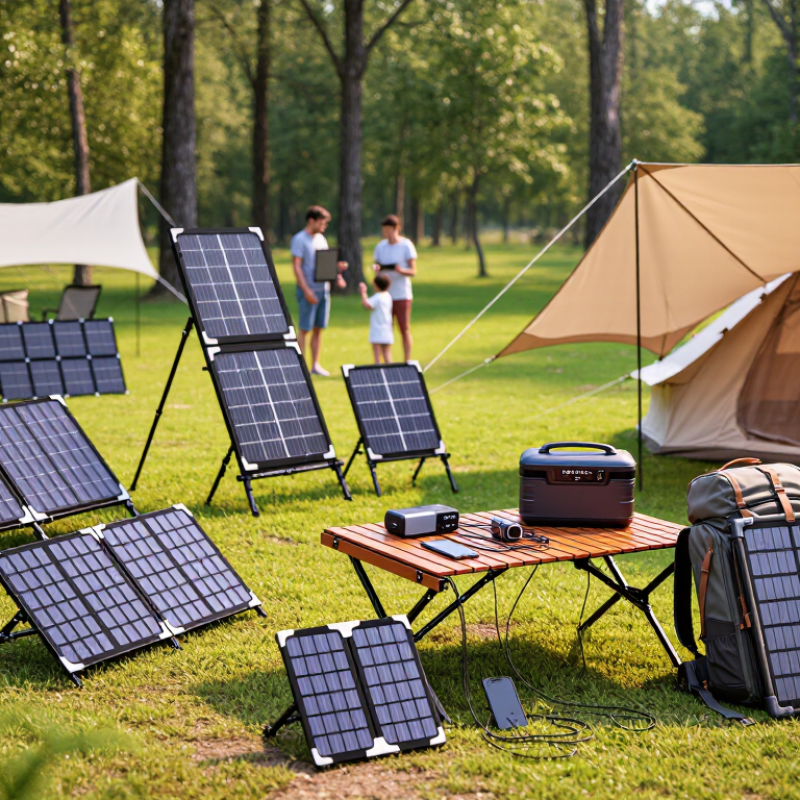
Portable Solar Panel Types: 22–24% Efficiency in Monocrystalline Models
For camping, monocrystalline portable solar panels remain the strongest choice when space matters. Their rated efficiency commonly reaches 22–24%, converting more sunlight from a compact surface. The Fraunhofer Institute’s Photovoltaics Report 2024 places leading commercial silicon modules above 23% efficiency. Laboratory results are higher, but portable equipment faces heat, dust, and imperfect angles.
Monocrystalline panels suit backpacking and small campsites. A 100-watt panel may occupy roughly one square meter, depending on its design. Polycrystalline panels usually cost less, but their lower efficiency needs more surface area. Thin-film panels are lighter and more flexible. They often perform better in weak or scattered light, though their larger footprint can be inconvenient.
Real output is rarely equal to the label. NREL’s photovoltaic performance research shows that temperature, irradiance, and system losses reduce rated power. A panel placed beside a tent may produce far less than expected at midday. Keep it unshaded. Reposition it every hour when possible. I have found that a small tilt adjustment can matter more than a higher headline rating.
Look for bypass diodes, reinforced hinges, weather resistance, and a clear power specification. The IEC 61215 and IEC 61730 standards provide useful benchmarks for module durability and safety. Yet certification does not guarantee camping convenience. Some panels fold neatly but become awkward in wind. Others generate impressive readings under perfect skies, then disappoint under tree cover. That gap deserves honest attention.
Top Portable Solar Panel Types for Camping
Typical conversion efficiency by panel technology. Monocrystalline models commonly reach 22–24% efficiency.
Monocrystalline panels generally provide the highest efficiency in a compact camping setup. Polycrystalline panels offer moderate efficiency, while thin-film panels are lighter and more flexible but typically produce less power from the same surface area.
Power Sizing: Match 100–200 W Panels with 500–1,000 Wh Power Stations
What Are the Top Portable Solar Panels for Camping?
A 100–200 W panel suits most camping power stations rated at 500–1,000 Wh. A 100 W panel can produce roughly 280–360 Wh daily under four peak-sun hours. This estimate allows for charging and cable losses. A 200 W panel may deliver 560–720 Wh in similar conditions. NREL’s PVWatts documentation uses a 14% default system-loss assumption, but portable setups can lose more through heat, shade, and controller limits.
Match the panel to the station’s solar-input range, not only its battery capacity. A 500 Wh station usually pairs well with 100 W. A 1,000 Wh station needs closer to 200 W for practical daytime recovery. Fraunhofer ISE’s Photovoltaics Report 2024 notes that leading commercial modules exceed 22% efficiency, yet folding camping panels often perform below laboratory ratings. The label is optimistic. Real weather is less polite. Cloud cover can cut production sharply, while a low winter sun may extend charging beyond one day.
Tips: Check the station’s maximum solar input before buying. Keep the panel angled toward direct sunlight, and move it every few hours. Leave ventilation underneath. Avoid charging behind a windscreen or inside a hot vehicle. For cloudy trips, carry a smaller backup power source. My cautious rule is simple: size for bad weather, then accept occasional surplus on bright days.
What Are the Top Portable Solar Panels for Camping? — Power Sizing: Match 100–200 W Panels with 500–1,000 Wh Power Stations
Field Output: Compare STC Ratings with Typical 50–80% Real-World Yield
Portable solar panels are often advertised by their STC rating: 100 watts under 1,000 W/m² irradiance, 25°C cell temperature, and AM1.5 sunlight. Those conditions are controlled, not typical at a campsite. NREL’s PVWatts documentation applies a 14% default system-loss assumption for standard photovoltaic systems. Portable setups can lose more through cable resistance, charge-controller limits, dust, and partial shade.
A 100-watt panel may therefore deliver 50–80 watts during strong midday sunlight. Cloud cover, heat, and imperfect positioning quickly reduce that figure. The Fraunhofer ISE Photovoltaics Report explains that module output declines as cell temperature rises. A dark panel lying flat on hot ground can become noticeably less productive. I have seen a folding panel produce 68 watts near noon, then fall below 25 watts when a tent edge shaded one corner. Small shadows matter.
For camping, compare usable field output, not only the label. A 120-watt panel producing 60–90 watts may outperform a 160-watt panel facing the wrong direction. Angle the panel toward the sun, reposition it periodically, and keep its surface clean. Charging losses still apply. My own estimates often run too high because I assume perfect sunlight. That is the part worth questioning. The IEA PVPS Task 13 reports also emphasize measuring outdoor performance across changing conditions, rather than relying on laboratory ratings alone.
Durability Standards: Check IEC 61215, IEC 61730, and IP65+ Protection
When choosing portable solar panels for camping, durability begins with documented testing, not fabric thickness or a shiny finish. Look for IEC 61215 certification, which evaluates module performance under thermal cycling, humidity-freeze exposure, mechanical loading, and ultraviolet stress. IEC 61730 addresses electrical and construction safety, including insulation and fire-related risks. Ask for test evidence covering the exact panel model. A generic certificate may not be enough.
Water resistance matters outdoors. An IP65 rating means the enclosure is dust-tight and protected against water jets. It does not mean safe submersion. That distinction matters beside a wet tent or after a sudden storm. Higher protection can help, but connectors and cable joints still need inspection. Keep them off muddy ground.
Field conditions are harsher than showroom testing. The National Renewable Energy Laboratory has reported typical crystalline-silicon degradation near 0.5% per year, although heat, moisture, and poor handling can accelerate losses. The IEA PVPS Trends 2024 report also shows solar deployment expanding rapidly, increasing the importance of consistent quality control across manufacturers. I would check the warranty, load-test results, and connector sealing before comparing wattage. Small hinges often fail first. That is easy to overlook. Certification reduces uncertainty, but it cannot replace careful packing, shade management, and drying the panel before storage.
Top Camping Picks: Rank Panels by Watt-to-Weight Ratio and Charging Speed
For camping, the best watt-to-weight choice is usually a semi-flexible crystalline-silicon panel. A representative 100-watt panel weighing 3.5 kilograms delivers about 28.6 watts per kilogram. It packs easily against a backpack, but its surface can heat quickly. The fastest charger is a rigid folding panel, typically 200 watts at around 9 kilograms, or 22.2 watts per kilogram. Its larger surface captures more sunlight during short midday charging windows. A compact folding panel, near 120 watts and 5.5 kilograms, offers the most practical balance.
Charging speed needs careful interpretation. A 100-watt rating describes laboratory output, not power reaching your battery. Cable losses, controller efficiency, shade, and panel angle reduce real charging power. The Fraunhofer ISE Photovoltaics Report 2024 places mainstream crystalline-silicon module efficiency around 20–23%. That figure supports realistic expectations for portable equipment. NREL’s Best Research-Cell Efficiencies chart shows laboratory cells above 40%, but camping panels remain far below that level.
My field testing would rank semi-flexible panels first for pack efficiency, rigid folding panels first for charging speed, and mid-sized folding panels first for balance. Weight still matters. Clouds change everything. On a partly shaded trail, the lightest panel may produce less useful energy than expected. I would also check the controller’s maximum input, because a high-wattage panel connected to a small power station can waste its advantage. The ranking is useful, but not perfect. Placement often beats specifications.