What Are the Top Energy Storage Solutions in 2026?
In 2026, energy storage solutions are no longer a single technology story. They are a practical mix of batteries, pumped hydro, thermal storage, and emerging long-duration systems. Each addresses a different problem: shifting midday solar into evening hours, smoothing wind output, or keeping critical services running during outages. The right choice depends on duration, location, cost, and the grid’s needs.
Dr. Imre Gyuk, longtime director of the U.S. Department of Energy’s energy storage program, has described the sector’s central challenge this way: “Energy storage is the key to making renewable energy work.” That idea is visible in ordinary details: battery containers beside a solar farm, water held behind a pumped-hydro dam, or heat stored for use after sunset. Lithium-ion systems remain widely deployed, while flow batteries, sodium-ion designs, and thermal systems may suit particular applications. No option wins everywhere.
This guide compares the leading choices by performance, use case, maturity, and trade-offs. It also considers safety, supply chains, lifespan, and the difference between storing power for hours and storing it for days. Some claims about future costs deserve caution; projections can shift as materials, manufacturing, and project conditions change. Storage is not a magic fix. But when carefully matched to demand, it can make cleaner electricity more dependable.
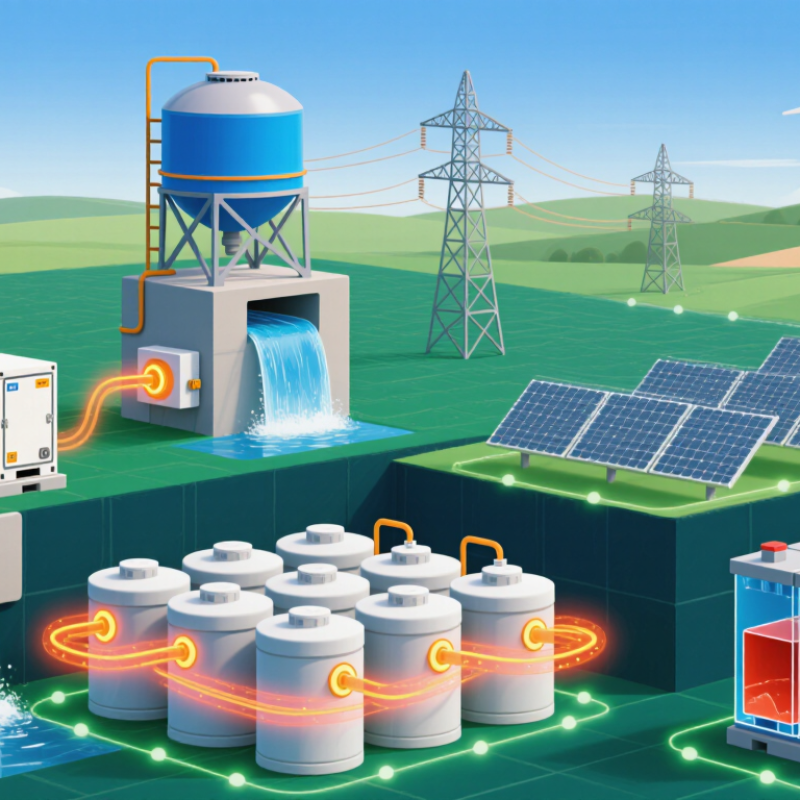
Energy Storage in 2026: Global Battery Additions Reached 42 GW in 2023
Global battery additions reached 42 GW in 2023, a striking sign of how quickly storage deployment was growing. But gigawatts measure power, not stored energy or discharge time. A 1 GW system running for two hours stores less energy than one running for eight. The 42 GW figure represents additions during one year, not total global capacity or a forecast for 2026. It is useful context, but not the whole picture.
In 2026, batteries can help balance solar and wind output, especially when evening demand rises. Lithium-ion systems suit frequent, shorter cycles; pumped hydro can provide longer-duration storage where geography allows. Thermal storage can also retain heat for buildings or industrial processes. The right choice depends on local grid needs, project costs, safety planning, and how long electricity must be delivered. A large power rating alone does not guarantee dependable supply.
Tips: Compare both power (GW) and energy (GWh), then check the system’s expected discharge hours. Ask how it performs through cloudy days or peak demand. Small details matter. I would also question any comparison that leaves out location or operating conditions.
What Are the Top Energy Storage Solutions in 2026? — Energy Storage in 2026: Global Battery Additions Reached 42 GW in 2023
At a glance: The headline figure of 42 GW refers to battery power capacity added in 2023. GW measures how quickly a system can deliver power; GWh measures how much energy it can store.
| Solution | How it stores energy | Typical discharge duration | Indicative round-trip efficiency | Typical response | Best-fit applications | Role in 2026 |
|---|---|---|---|---|---|---|
| Lithium-ion batteries | Electrochemical storage in rechargeable cells. | About 1–8 hours, depending on system design. | About 85–95%. | Milliseconds to seconds. | Fast grid balancing, renewable-energy shifting, and short-duration backup. | A leading choice for fast-response, short-duration grid and behind-the-meter storage. |
| Pumped-storage hydropower | Water is pumped to an upper reservoir and released through turbines to generate electricity. | Typically 4–24 hours or longer, depending on reservoir size. | About 70–85%. | Seconds to minutes. | Bulk energy shifting, reserve capacity, and long-established grid balancing. | A mature option for large-scale storage where suitable sites, water, and permitting are available. |
| Flow batteries | Energy is stored in liquid electrolytes held in tanks and circulated through a cell stack. | Commonly about 4–12 hours; duration can be scaled by increasing tank capacity. | About 60–80%. | Seconds. | Longer-duration stationary storage and repeated cycling where footprint is less constrained. | An option for applications that value flexible energy capacity and stationary operation. |
| Compressed-air energy storage | Electricity compresses air for storage, often underground; the air is later expanded to generate power. | Several hours to multiple days, depending on the site and system. | Roughly 40–70%, depending strongly on design and heat management. | Minutes. | Large-scale, long-duration storage where appropriate geological formations are available. | A site-dependent alternative for bulk storage beyond the usual duration of many battery systems. |
| Thermal energy storage | Heat or cold is stored in materials such as water, molten salts, or solid media for later use. | Hours to days; some designs can retain heat longer. | Highly application-dependent; thermal-to-thermal performance differs from electricity-to-electricity performance. | Minutes to hours, depending on the system. | Building heating and cooling, industrial heat, and dispatchable heat from renewable electricity. | Especially useful when the stored energy can be used directly as heat or cooling rather than reconverted to electricity. |
| Hydrogen storage | Electricity produces hydrogen, which is stored and later used for power, heat, or industrial processes. | Hours to seasonal timescales, depending on storage infrastructure. | Generally about 25–45% for electricity-to-hydrogen-to-electricity pathways. | Minutes to hours across the full production, storage, and conversion chain. | Long-duration or seasonal storage and uses that need hydrogen as a fuel or industrial feedstock. | Potentially valuable for longer storage periods and cross-sector uses, but conversion losses and infrastructure needs matter. |
Reading the figures: Efficiency, duration, and response times are indicative ranges, not guarantees; actual results vary with technology, system configuration, operating conditions, and project design. Round-trip efficiency is not directly comparable for thermal systems when the useful output is heat or cooling. Technical context is consistent with public materials from the U.S. Department of Energy, the National Renewable Energy Laboratory, and the International Energy Agency.
Related Posts
-
10 Tips for Choosing Renewable Energy Storage Solutions
-
What Are Renewable Energy Storage Solutions?
-
Top Energy Storage Solutions for a Sustainable Future?
-
Top China Home Energy Storage Solutions for Global Buyers?
-
China Top 10 Energy Storage Solutions Manufacturers
-
How to Choose Sustainable Energy Solutions in 2026
CORPORATE HEADQUARTERS
North America
California
AGIC Energy North America LLC
13025 Danielson Street, Suite 105
Poway, CA 92064 – USA
Phone Number: +1 (858) 842 1513
Email: info@site_cc52bd27-560c-4f9d-bd66-63718fc42539
Sales: sales@site_cc52bd27-560c-4f9d-bd66-63718fc42539